How to Buy a Phone with Bitcoin (2026): What Actually Works
Aug 3, 2026 · AppleBitcoin
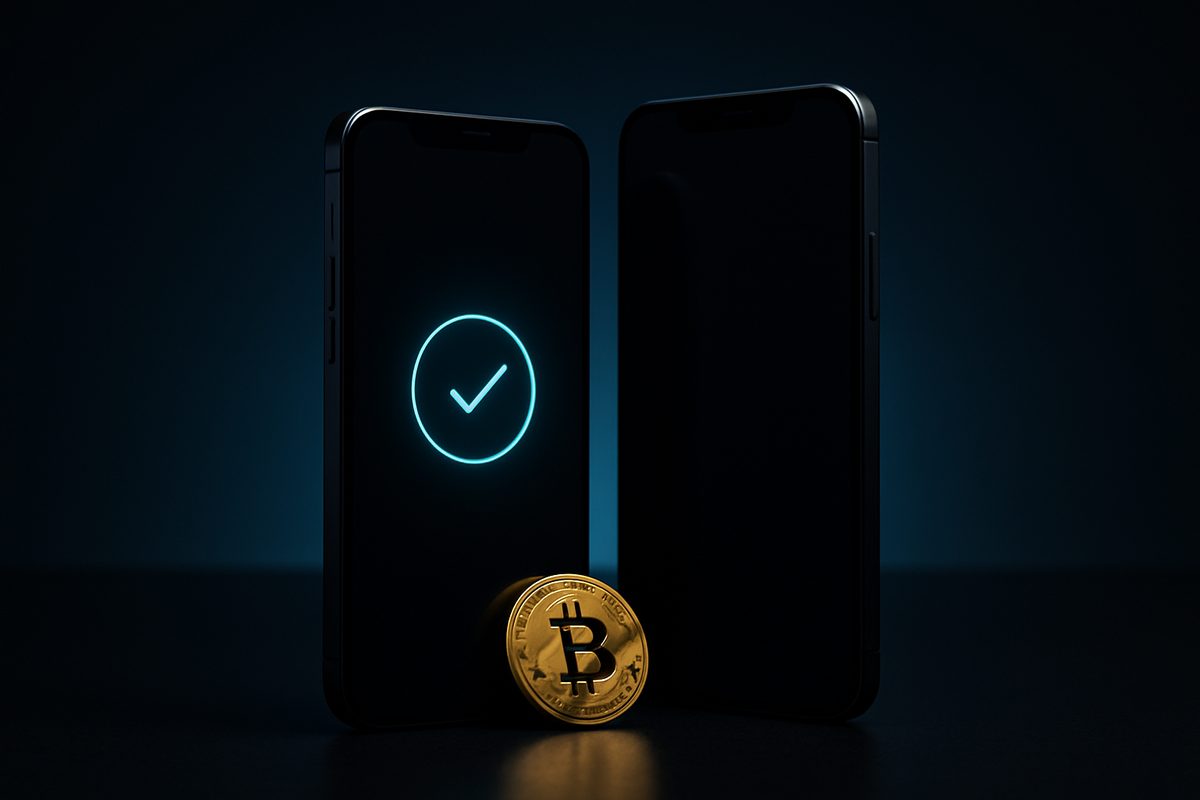
You can't walk into an Apple Store, a Samsung shop or a carrier and pay for a phone in Bitcoin. Not one of them accepts it at checkout in 2026. But people buy phones with crypto every day, and there are four genuinely different routes to do it — with very different costs, warranty outcomes and levels of protection.
This guide covers what actually works, what it really costs once you account for network fees and tax, and how to tell a legitimate crypto seller from the ones that take your money and disappear.
First: nobody sells phones for crypto directly
Worth being precise, because plenty of articles imply otherwise.
| Seller | Accepts crypto? | What they do accept |
|---|---|---|
| Apple | No | Apple Pay, Apple Card, credit/debit, PayPal, Apple Gift Cards, Apple Account Balance |
| Samsung US | No | Cards, PayPal, Samsung Pay, Google Pay, Amazon Pay, Venmo, Affirm, Klarna |
| Google Store | No | Cards, PayPal, Google Store financing — and it publishes an explicit "invalid methods" list |
| Verizon | No | Bank accounts, cards, gift cards, cash |
| T-Mobile | No | Cards, bank account, AutoPay, in-store |
| AT&T | Bills only | Lists BitPay among online payment methods when signed in |
AT&T is the one genuine exception and it's narrower than it sounds. Its support page — updated April 2026 — lists BitPay as an accepted method, but it appears under bill payment, not device checkout. You can pay your monthly bill with crypto. You can't buy a handset that way. And AT&T never touches crypto: BitPay converts to fiat and settles fiat.
One thing to not confuse: Samsung announced stablecoin support in Samsung Wallet at Unpacked 2026. That's a wallet feature, not a Samsung.com checkout option, and no launch date is confirmed.
The four routes that do work
| Route | Real cost on $1,000 | Warranty | Buyer protection |
|---|---|---|---|
| Crypto-accepting reseller | Network fee only (cents to a few dollars) | Manufacturer warranty on genuine sealed units | Merchant policy only — no chargeback |
| Crypto debit/credit card | Conversion spread, ~0.5% on stablecoins | Full — you buy direct from Apple/Samsung | Best — full Visa/Amex dispute rights |
| Gift card bought with crypto | ~1% markup + network fee | Full — purchase is from Apple itself | Weak — codes are effectively cash |
| P2P / marketplace | Lowest headline price | Only if genuine; you inherit the original date | None |
The crypto card route deserves more attention than it usually gets, because it's the only one that keeps both protections intact: you buy direct from the manufacturer, so warranty and returns are normal, and the merchant leg is an ordinary card transaction with full dispute and chargeback rights. The only thing you give up is that converting crypto to fiat is itself irreversible — and taxable.
Which crypto cards actually work in 2026
This is where most guides are badly out of date, because they still recommend a card that has been dead for three years.
| Card | Region | Rewards | Status |
|---|---|---|---|
| Coinbase Card (Visa debit) | US, all states except Hawaii | Rotating crypto rewards | Live, $0 annual fee |
| Coinbase One Card (Amex) | US only | 2–4% bitcoin back, tiered by assets held | Live; needs Coinbase One |
| Crypto.com Visa | 36 markets; US except New York | 0–5% by tier and CRO stake | Live |
| Nexo Card | EEA + UK only | Up to 2% | Live — not available in the US |
| BitPay Card | — | — | Discontinued June 2023; applications still paused |
The BitPay Card shut down in June 2023 when its banking partner exited crypto. Three years on it hasn't relaunched — there's a waitlist and no announced date. If a guide tells you to get one, that guide hasn't been updated since 2022.
The honest summary for a US buyer: Coinbase Card, Coinbase One Card, or Crypto.com outside New York. Nexo and Wirex are Europe-only.
The cost nobody mentions: tax
In the US, spending crypto is a taxable disposal. The IRS treats digital assets as property, not currency, and disposing of them "in exchange or trade for property, goods or services in any amount" is a reportable event.
Practically: buying a $1,200 iPhone with Bitcoin you acquired at $300 is two events in the eyes of the IRS — a sale of Bitcoin at $1,200, generating a taxable gain on the appreciation, and a purchase of a phone. You check "Yes" on the Form 1040 digital-asset question and report the gain on Form 8949 and Schedule D. Short-term if you held it a year or less, long-term beyond that.
Two 2026-specific points worth knowing. Brokers must now file Form 1099-DA, reporting gross proceeds for transactions from 1 January 2025 and cost basis for transactions from 1 January 2026 — and the regulations explicitly cover certain digital-asset payment processors. Your phone purchase can end up on a form.
The UK works the same way: HMRC lists "using them to pay for goods or services" as a disposal for Capital Gains Tax, and Self Assessment has had a dedicated cryptoasset section since the 2024–25 tax year.
None of this is a reason not to do it. It's a reason to keep records — and if you have a large unrealised gain, worth a conversation with an accountant. We're not tax advisers, and this isn't tax advice.
Which network to use for a $500–$1,500 phone
Fees measured in August 2026, and the conventional wisdom has flipped:
| Rail | Typical fee | Verdict |
|---|---|---|
| USDC on Solana | Well under $0.01 | Cheapest |
| USDC on Base | Well under $0.01 | Cheapest |
| Bitcoin Lightning | Fractions of a cent | Excellent, if supported |
| Bitcoin on-chain | ~$0.09–$0.18 in a calm mempool | Fine; rises sharply with congestion |
| USDT on TRON | ~$2.17–$4.40 without staked energy | No longer the cheap option |
That last row surprises people. TRON was the default "cheap stablecoin" recommendation for years, and in 2026 it's one of the more expensive rails unless you stake TRX or rent energy.
But here's the caveat that matters more: the network fee is rarely your biggest cost. Your exchange's withdrawal fee — often a flat $1–$5, or a fixed BTC amount well above the on-chain rate — usually dominates. Check the withdrawal fee per network before you pick a coin. Our cheapest crypto network guide breaks this down in detail.
Warranty: what survives, what doesn't
The manufacturer warranty travels with the device, not the payment method. Apple's One-Year Limited Warranty covers hardware defects "from the date of original retail purchase by the end-user purchaser."
Three consequences worth understanding before you buy from any reseller:
- The clock starts at original retail purchase, not when you receive it. A unit that sat in stock for eight months has eight months less coverage.
- Service by non-authorised parties voids coverage. Apple excludes damage from service performed by anyone who isn't Apple or an Authorised Service Provider.
- Cross-border service is the real trap. Apple only offers international service "where available," and you're responsible for duties and taxes. A grey-import handset from another market can leave you with a device Apple won't service locally.
On the payment side, the FTC is blunt: "Cryptocurrency payments do not come with legal protections... Cryptocurrency payments typically are not reversible." That's the trade-off. A crypto payment is final in a way a card payment isn't — which is exactly why who you buy from matters more than it would with a card.
How to spot a legitimate crypto seller
Crypto fraud is not a small problem. The FBI's IC3 recorded 181,565 cryptocurrency fraud complaints totalling more than $11 billion in 2025 — up around 22% year on year, and more than half of all reported internet-crime losses.
Red flags, in rough order of how reliably they predict a scam:
- Crypto-only, no alternative. The FTC's line — "only scammers demand payment in cryptocurrency" — needs nuance for a crypto-commerce audience: legitimate crypto merchants offer crypto alongside other methods. A seller who refuses every other option is the tell.
- Prices far below retail. A sealed current-gen flagship at 30–50% off is stolen, counterfeit, non-existent, or a grey import.
- A raw wallet address instead of a proper invoice. Legitimate checkouts show a locked crypto amount, an invoice ID and a countdown — see below.
- No company identity. No registered entity, no address, Telegram-only contact, no published returns policy.
- Coin or network switched mid-flow. "Send it on TRON instead" after quoting BTC is a classic address-swap move.
- "You underpaid, send more." Real processors automatically refund partial payments; they don't ask for top-ups.
Why the price lock matters
A legitimate crypto checkout quotes your crypto amount at a locked exchange rate with a short expiry — BitPay, for example, guarantees the rate for 15 minutes. Pay inside the window and the rate is honoured. After it expires, the rate is no longer guaranteed and late payments aren't automatically applied.
If a checkout shows you a fiat price and a bare wallet address with no locked amount, no invoice and no timer, you're carrying all the price risk between broadcast and confirmation — and you've handed the seller an excuse to claim underpayment later. That's not a minor UX difference. It's the difference between a payment processor and a person with a wallet.
For what it's worth, this is why our own checkout locks your amount for 20 minutes and shows the exact figure and address up front.
The straightforward option
If your aim is simply to own an iPhone and pay in crypto, the shortest path is a reseller that accepts it natively — no card conversion, no gift card region locks, no P2P risk.
At AppleBitcoin you can buy genuine, sealed iPhones and other Apple products and pay in Bitcoin or any of 30+ cryptocurrencies, with a locked price at checkout, full Apple warranty and free insured worldwide shipping.
If you're deciding which handset, our best phone for crypto in 2026 compares the options for people who actually hold and use crypto, and should you wait for the iPhone 18 covers the timing question. Before buying from anyone — us included — how to spot a scam store is the one to read.
Frequently asked questions
Can I buy an iPhone directly from Apple with Bitcoin?
No. Apple's payment methods are Apple Pay, Apple Card, credit and debit cards, PayPal, Apple Gift Cards, Apple Account Balance and its financing options — no cryptocurrency. The workarounds are a crypto-funded card (Apple sees an ordinary Visa or Amex), an Apple Gift Card bought with crypto, or a reseller that accepts crypto directly.
Does any carrier accept crypto?
One, and only for bills. AT&T's support page lists BitPay among accepted online payment methods when you're signed in to your account — but it's a bill-payment option, not a handset checkout option, and BitPay converts to fiat before AT&T receives anything. Verizon and T-Mobile list no crypto option at all.
Is the BitPay Card still available?
No. BitPay and its banking partner shut the card down in June 2023 when the bank exited crypto banking, and three years later it still hasn't relaunched — applications are paused with only a waitlist. In the US the working alternatives are the Coinbase Card, the Coinbase One Amex card with 2–4% bitcoin back, and Crypto.com's Visa outside New York.
Do I owe tax if I buy a phone with Bitcoin?
In the US, yes. The IRS treats digital assets as property, and disposing of them in exchange for goods or services in any amount is a taxable event reported on Form 8949 and Schedule D. Your gain is the phone's fair market value minus your cost basis in the crypto. The UK is the same — HMRC lists using cryptoassets to pay for goods as a disposal for Capital Gains Tax. This isn't tax advice; keep records and speak to an accountant on large gains.
Which coin and network should I use for a $1,000 phone?
On raw network cost in August 2026, USDC on Solana or Base costs well under a cent, Lightning is fractions of a cent, and Bitcoin on-chain ran about $0.09–$0.18 in a calm mempool. USDT on TRON — long the default "cheap" answer — now costs roughly $2 to $4.40 unless you stake TRX. In practice your exchange's withdrawal fee and the merchant's supported coins matter more than the network fee, so check both before sending.
Ready to buy Apple with crypto?
Genuine, sealed Apple products. Pay in Bitcoin, Ethereum or stablecoins.
Shop now